Nucleate UK Eco Agronomist Salon: Where Start-Up Ambition Meets On-Farm Reality

Rosalie Sanders
Aug, 31 2026As part of the Ceres Innovation Group, we’re sharing monthly reflections on the innovations, technologies and ideas shaping agriculture. The aim isn’t simply to highlight new products or alternative approaches, but to explore where they may add value in practical farming systems, and where further evidence is needed before widespread adoption. This month, we are reflecting on the discussion and networking session held by Nucleate UK in Oxford back in May. The event brought together early-stage ag-tech founders, researchers, investors and agronomists to explore how science-led innovation can move from concept to commercially useful, farm-ready solutions.
Panel Discussion
The evening started with a panel discussion, with our own Dr Dannielle Robb sharing her experience with ag-tech innovation, translation, and on-farm validation, while company founders highlighted the key hurdles faced by early-stage ag-tech startups. Innovation in agriculture is moving quickly, but adoption depends on more than just novelty. Too often, new technology is developed first and only later tested against practical on-farm needs. The panel discussion highlighted the importance of engaging farmers and agronomists as early as possible to understand the real-world problems faced within the industry and ensure that the technology developed provides a practical solution. The panel highlighted that adoption of a new technology or alternative approach relies on whether it solves a real problem, can be used within existing operations, and has sufficient evidence behind it to justify both its cost and the risks associated with changing existing practice.
Ag-Tech Pitches
The evening continued with presentations from four ag-tech startups / researchers.
Watney Labs is developing AI tools for plant breeding and crop adaptation. Its work focuses on integrating plant genetics and environmental data so that breeders and seed companies can simulate how varieties may perform across different locations, seasons, and target environments. The start-up highlighted the challenge of fragmented agricultural data and pitched its new WhatsApp AI agent as a way to organise, analyse and make better use of diverse farm data. The agent draws data from across the farming enterprise, as well as plant and environmental datasets, to deliver real-time in-field insights or carry out farm management tasks, such as creating budgets and cashflows.
GainsBio presented their work on soil-optimised microbial products. Rather than taking a ‘one-size-fits-all’ approach to biological inputs, GainsBio tailors their biological inputs with bespoke mixes of microbes proven to survive and perform in specific soil conditions, such as drought-prone, saline or acidic environments. This approach aims to maximise the success of a biological application, treating the exact in-field problem with microbes proven to alleviate plant stress under those specific conditions.
Yordan Dolapchiev presented the research he has carried out on plant gene-editing for crop disease resistance, with his latest work focussing on late blight resistance in potatoes. Late blight remains one of the most economically significant potato diseases and is traditionally managed through the selection of resistant varieties and intensive fungicide programmes. New plant breeding and gene-editing approaches could accelerate the development of more durable resistance traits, and highlight how science and technology can be deployed to find solutions to long-standing industry challenges.
Aeropod, developed by Muju Earth, is a biodegradable soil aeration capsule designed to respond to compaction and waterlogging. The capsule is drilled like a seed and, when triggered by specific soil conditions, helps create air, water and nutrient pathways while adding beneficial microbial inputs. The concept is particularly interesting because it targets soil physical health, often the overlooked foundation for biological and chemical soil function. For farmers and agronomists, the practical questions will be around cost, application timing, compatibility with drilling systems, field-scale performance and whether the benefits can be measured consistently across different soil types and seasons.
Agronomy Round-Table Discussion
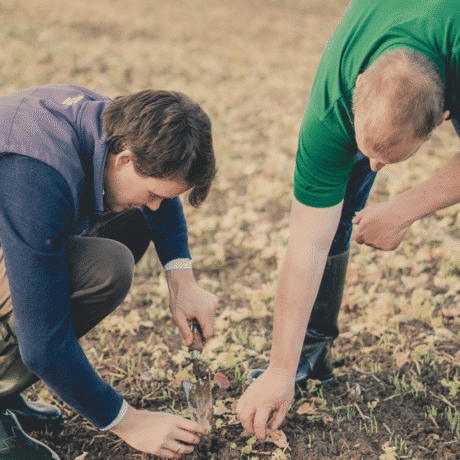
Afterwards, the ag-tech pitch delegates were divided into round-table discussion groups with at least one representative from research, innovation, facilitation, and agronomy. Ceres Rural agronomists had been invited to the event to give start-ups the opportunity to quiz independent agronomists directly about the barriers they experience in testing and adopting new technologies or approaches, and how these might be overcome. This was one of the most valuable parts of the event because it moved the conversation from “what can the technology do?” to “what would make a farmer or adviser use it?”
Several themes were clear. There are lots of people with good ideas within the research and innovation space who are looking for opportunities to engage directly with farmers and agronomists to test and develop their innovations. And crucially, farmers and agronomists are keen to test new technologies. However, farmers are often time and cash-poor and so new solutions need to address real problems, provide clear economic or operational value, and be simple enough to integrate into existing farm workflows. Independent, on-farm evidence matters: yield responses, input savings, labour reductions, soil health benefits and risk reduction need to be demonstrated under real-world commercial farm conditions, not just in controlled environments.
Start-ups also need access to honest technical feedback, relevant farm trial sites, credible data, and routes into farming and agronomy businesses. Many founders understand the science extremely well, but benefit from early engagement with farmers and agronomists who can challenge assumptions around use cases, seasonality, machinery compatibility, farmer priorities and the realities of decision-making in busy commercial systems.
Building Momentum
Events such as the Nucleate UK Eco Agronomist Salon are a useful reminder that agricultural innovation is strongest when it is developed with end users, not simply for them. The event reinforced the importance of keeping innovators, researchers, farmers and agronomists in the same conversation from the earliest stages of product development, particularly when considering three key questions:
- Does it solve a genuine farming challenge or problem?
- Does it fit within existing workflows where relevant?
- Can it generate value that exceeds its cost?
This is where Ceres Research and the Ceres Innovation Group can help bridge the gap. By combining rigorous research capability, agronomic expertise and access to commercial farming systems, Ceres Research supports innovators through its Define > Develop > Demonstrate approach and Ag Innovator membership. Our aim is not to chase every new product or solution, but to identify where innovation could solve a real problem, test it robustly, and share what is learned with farmers and advisers.
Over the coming months, we’ll continue sharing insights from across the industry, highlighting not just the newest innovations, but the technologies and alternative approaches most likely to deliver meaningful value in commercial farming systems.
If you are a farmer or an innovative ag-tech company interested in getting involved, please contact us here.