Ceres Rurals response to the Farming Profitability Review

Phoebe Eglington
Jul, 13 2026Farming Roadmap 2050 – What DEFRA’s Long-Term Vision Means for Farmers
Following the publication of Minette Batters’ Farming Profitability Review and the Government’s Environmental Improvement Plan (EIP25) earlier this year, DEFRA has now set out its own long-term vision for agriculture through the Farming Roadmap 2050.
The roadmap sets out the Government’s long-term vision for English agriculture over the next 25 years and signals a continued transition away from “subsidy-supported farming” towards a “market-led farming sector with targeted payment for public goods”, where farm businesses are expected to be increasingly driven by productivity, innovation and environmental markets.
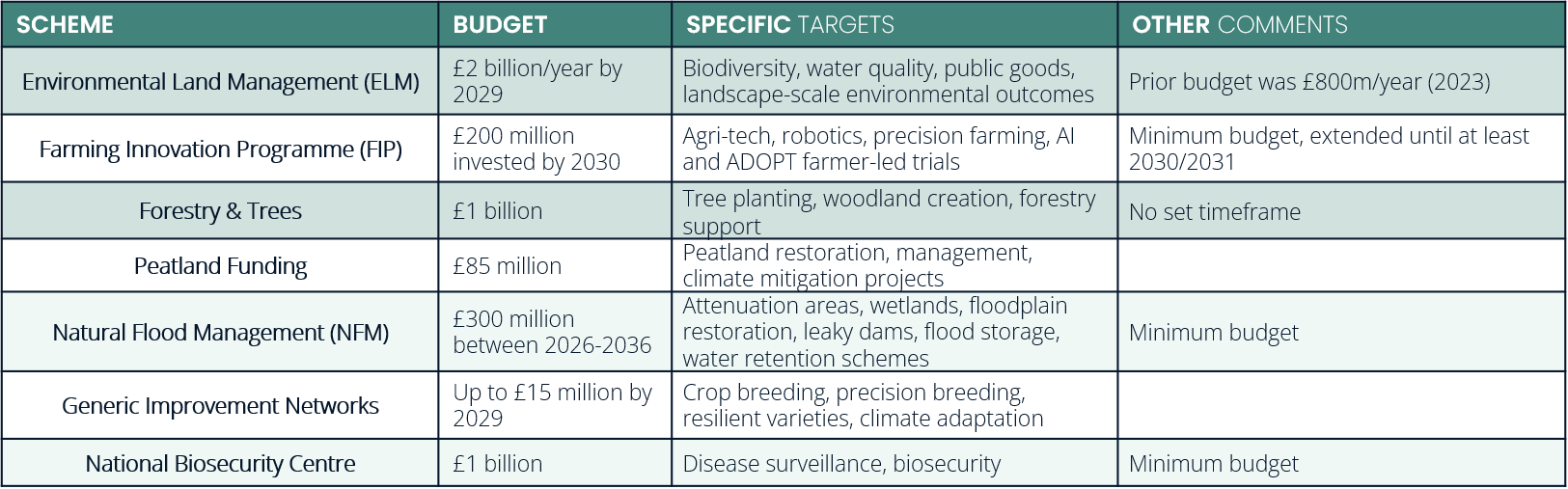
The roadmap includes the latest update on the allocation of budgets for various existing schemes, highlighted in the table below.
Environmental Land Management (ELMs)
SFI and Environmental Payments
Actions that are currently being incentivised through Sustainable Farming Incentive payments could eventually become part of standard farming practice under regulation, and therefore no longer be eligible for support payments after 2030. This includes measures such as nutrient management, pollution prevention, soil protection and the use of buffer strips.
For farmers, this reinforces the importance of using current schemes to prepare businesses for the future, rather than viewing environmental payments as a permanent income stream. Rather than paying farmers to meet minimum standards, future support will increasingly focus on delivering outcomes above regulatory requirements.
Countryside Stewardship Higher Tier (CSHT)
The roadmap confirms that Countryside Stewardship Higher Tier (CSHT) will continue and expand, with targeted support for protected and designated sites, priority habitats, landscape-scale recovery and high-value environmental outcomes.
Increased Regulations
Alongside changes to SFI, DEFRA has signalled a tightening of environmental regulation over the coming decade. The Environment Agency’s inspection capacity is expected to double by 2029, supported by greater use of remote sensing, satellite imagery, geospatial monitoring and risk-based enforcement.
DEFRA also intends to simplify existing water legislation by replacing the current patchwork of regulations with a single agricultural water regulation covering pollution prevention and water quality.
Targeted Environmental Funding
The second biggest policy shift is the move towards greater spatial targeting of environmental funding.
Future environmental schemes are expected to focus funding in locations where government believes it can achieve the greatest environmental benefit, including:
- Priority river catchments
- Water quality hotspots
- Nature recovery areas
- Woodland opportunity zones
- Protected landscapes
- Peatland areas
Some farmers will already be familiar with this approach through schemes linked to water company catchments such as Thames Water and Severn Trent STEPs. The roadmap suggests this targeted approach will become far more widespread across future environmental funding.
What About Livestock Businesses?
For the livestock sector, DEFRA is considering whether environmental permitting requirements should be extended to intensive beef and dairy systems, similar to the permitting regimes already applied to larger pig and poultry enterprises. Formal consultations are expected before any changes are introduced, but the proposal signals increasing attention on emissions, nutrient management and environmental performance across all livestock sectors.
The Government has also reaffirmed its commitment to the Animal Health and Welfare Pathway, which will continue to support veterinary reviews, animal health planning, disease eradication programmes and improved biosecurity measures.
In relation to bovine TB, DEFRA plans to deploy cattle TB vaccines and DIVA testing by 2030, with a target for England to achieve TB-free status by 2038.
New Income Opportunities Beyond Food Production
Whilst government support may become more targeted, the roadmap places considerable emphasis on the growth of environmental markets as a future source of farm income.
Opportunities are expected to expand in areas such as:
- Carbon sequestration
- Soil carbon projects
- Woodland creation
- Peatland restoration
- Biodiversity markets
- Natural flood management
- Water quality schemes
Demand for Biodiversity Net Gain (BNG) units is also expected to increase further when mandatory BNG requirements are extended to Nationally Significant Infrastructure Projects from November 2026.
Woodland creation, timber production and agroforestry feature strongly throughout the roadmap, with government viewing these as increasingly mainstream diversification opportunities rather than niche enterprises.
Improved Prospects for Tenant Farmers
DEFRA has committed to reforming the Farm Tenancy Forum, increasing tenant representation, reviewing legislation, supporting longer-term agreements and improving tenant access to environmental schemes. While details remain limited, the recognition of barriers faced by tenant farmers is encouraging.
If you have any questions, please do not hesitate to contact one of the farming team here.