Farmland Market Update Q2 2026: England Land Prices, Demand & Market Outlook

Tim Isaac
Aug, 07 2026The first half of 2026 has been a tale of two quarters. Supply was slow to emerge early in the year, with prolonged wet weather during January and February delaying planned launches. The outbreak of war in the Middle East (28th February) then added to an already uncertain geopolitical backdrop, encouraging both buyers and vendors to take stock before committing. A late flurry of farms came forward during the second quarter, giving buyers more choice. While this has helped supply recover from its slow start earlier in the year, the volume of land being marketed remains about 20% below the level seen at the same point in 2025.
Average land values have eased back slightly, but headline figures mask a wide range of outcomes. We have agreed sales at around £15,000 per acre for exceptional farms in popular locations, while more secondary land in remote areas, with no amenity or strategic appeal, has been agreed at closer to £8,000 per acre. This reflects an increasingly polarised market.
Ceres Research Insight: Productive Capacity Remains a Key Consideration
Growing conditions during the first half of 2026 were highly variable across England, with moisture stress affecting crops during key growth stages and yield expectations becoming increasingly dependent on soil type and local rainfall patterns. A dry spring across much of England increased pressure on crops, and while June rainfall improved prospects in some situations, production uncertainty remained a key consideration for many farming businesses.
This uncertainty highlights the importance of productive capacity and resilience within modern farming systems. As weather patterns become less predictable, factors such as soil characteristics, water availability and the ability of land to perform consistently under different conditions are becoming increasingly relevant to agricultural performance.
Competitive bidding remains evident for farms with productive land, good infrastructure, strong access and water or irrigation. Residential farms offering an attractive house, sensible acreage, useful buildings and an accessible location have also continued to perform well.
Farming profitability remains a key influence on demand. Tighter margins, reduced support, higher finance costs and continued policy uncertainty mean buyers are looking more closely at the return an acquisition could deliver. This is particularly relevant for bare land lacking amenity or strategic appeal, as well as purely commercial farms which must stand on their agricultural merits alone; these are taking longer to sell and are subject to greater scrutiny from buyers.
Ceres Research Insight: Profitability and Agricultural Support Continue to Diverge
Profitability Pressures Remain Uneven
Defra’s latest forecasts point to a significant divergence in farm business performance across the agricultural sector (Figure 1). Farm Business Income on cereal farms is forecast to fall by 66% to £17,000 in 2025/26, while general cropping income is forecast to fall by 50% to £54,000. In contrast, dairy farm income is forecast to increase by 45% to £224,000 and lowland grazing livestock income by 9% to £45,000.
Defra identifies lower cereal prices, highly variable yields, reductions in delinked Basic Payment support and continuing input cost pressures as key contributors to weaker arable farm profitability. The forecasts highlight substantial differences in profitability across farm sectors in 2025/26.
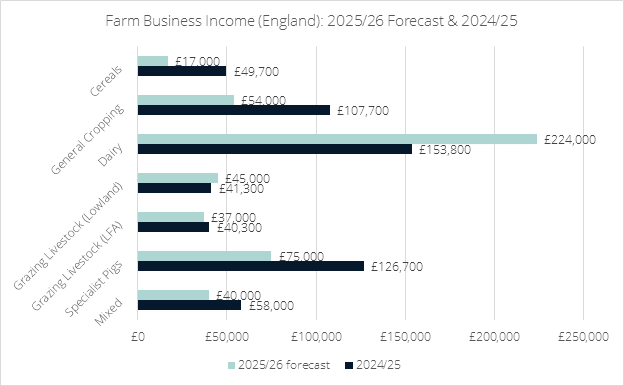
Figure 1. Average Farm Business Income by farm type in England, 2025/26 forecast & 2024/25. Defra forecasts indicate a sharp fall in arable farm profitability in 2025/26, while dairy and lowland grazing livestock incomes are forecast to increase. Source = Defra, March 2026.
Agricultural Support Continues to Evolve
The agricultural support landscape continues to transition away from legacy direct payments. While opportunities remain available through schemes such as the Sustainable Farming Incentive (SFI) and Countryside Stewardship (CS) Capital Grants, support is becoming increasingly structured, capped and budget-led. SFI 2026 reopened with a £240 million annual budget, with new agreements subject to a £100,000 limit per SBI and a number of actions seeing reduced payment rates compared with previous offers.
Alongside continued reductions in delinked Basic Payment support, these changes reinforce the importance of business planning and careful funding scheme selection. Support remains available, but farming businesses are increasingly required to navigate a more structured and targeted support landscape.
Despite continued profitability and agricultural policy pressures, demand nevertheless remains from farmers who have diversified successfully or have income beyond the farm business, as well as rollover buyers in the right locations. Institutional interest has cooled and become more selective, with greater focus on land that adjoins or strengthens existing holdings. Farmland’s long record of delivering stable, long‑term returns continues to underpin its appeal, and we are still seeing landowners prepared to bid where the right deal fits their business and is financially achievable, despite the current market backdrop.
References
Ceres Research (2026) Weather Data Dashboard
Ceres Rural (2026) Farming Update: July 2026
Defra (2026) Forecasts of Farm Business Income by type of farm, England, 2025/26
Farm & Estate Valuations
With land values varying significantly according to location, quality and potential, obtaining an accurate valuation has never been more important. If you’re considering a sale, purchase or simply want to understand the current market value of your farm, estate or land, our Farm Agency team offers free, no-obligation valuations. To find out more, contact Peter Mason at peter.mason@ceresproperty.co.uk.
Stay up to Date
Be the first to hear about new farms, estates, land and rural properties coming to the market. We regularly send property alerts to prospective buyers and investors with details of our latest instructions.
If you would like to receive these updates, please complete our form here and let us know the types of properties you’re interested in, along with your preferred location and budget, and we’ll keep you informed of relevant opportunities.